If a child becomes confused, has a seizure, loses consciousness or has severe breathing difficulty after heat exposure, seek emergency help and start cooling immediately; do not wait to finish this guide. For an outing still being planned, the question is broader than whether outside is allowed today. What will the child do, where, and how easily can you leave? Air quality and heat are separate conditions: a reassuring result for one cannot cancel a warning about the other.
The short version
- 01
Read the AQI scale, location and update time; an old screenshot is not a current reading.
- 02
Adapt timing, exertion and the exit route to both pollution and humid heat.
- 03
Masks, shade and air conditioning address different problems; none is permission to prolong a risky outing.
Jump to the part you need
Two mornings, two reasons to change plans
Imagine a morning with good AQI but a hot, still playground and nowhere cool to retreat. On another morning the air feels pleasantly cool, yet the pollution reading is poor. These are hypothetical situations, not current reports for Hanoi or Ho Chi Minh City. The first calls for reducing heat exposure; the second calls for reducing pollution exposure. Simply leaving earlier may not solve both. The sky's appearance and an adult's sense of comfort are not substitutes for environmental information.
Before interpreting a number, identify whether the app uses VN_AQI or another country's scale, where its data comes from and when it was updated. VN_AQI has hourly and daily values; yesterday's summary cannot guarantee conditions at departure. PM2.5 concentration and an AQI score are also different measurements. When apps disagree, compare their scale, location and timing instead of choosing the lower number for reassurance. Missing useful data means uncertainty, not automatically good air.
Use VN_AQI to change the activity, not calculate guaranteed safe minutes
Viet Nam's environmental monitoring authority defines VN_AQI bands, while the Ministry of Health advises reducing activity as pollution worsens. Children warrant particular care, especially with asthma or heart or lung conditions. The options below are NIMO's cautious family-planning adaptation, not school-closure rules. If an app uses US AQI, consult that system's accompanying guidance rather than transplanting Vietnamese category labels.
A colour boundary is not a biological cliff, and no universal number of minutes guarantees safety for every child at a given reading. A gentle stroll differs from continuous chasing; a child already coughing differs from one feeling well. Follow any clinician-agreed asthma plan and carry prescribed medicines. There is no need to wait for the highest category before changing plans, and one symptom-free outing does not prove the next will be safe.
- VN_AQI 0-50: good; 51-100: moderate. Consider outdoor time if heat and health permit; sensitive children may still need less activity if symptoms occur.
- VN_AQI 101-150: poor. Shorten outdoor time and avoid prolonged vigorous activity or locations beside pollution sources.
- VN_AQI 151-200: bad. For a young child's play outing, prefer an indoor option with cleaner air.
- VN_AQI 201-300: very bad, minimize outdoor activity; 301-500: hazardous, avoid outdoor activity. Postpone optional play rather than try to complete it.
Humid heat is a separate decision
WHO explains that heat, humidity, little air movement and strong radiant heat can impair the body's ability to lose heat. The temperature on a screen is therefore only part of the picture. Consider local heat warnings, humidity or an available feels-like estimate, then picture the actual setting: paving, an outdoor queue, a vehicle seat or a shaded area. Good AQI does not override a heat warning, and shade does not automatically make polluted air cleaner.
Choose a cooler part of the day according to actual conditions, not a fixed hour assumed always safe. Lightweight clothing, cooling breaks and sun protection still matter; UV information is separate from AQI. Keep a stroller ventilated and the child visible rather than enclosing it with a blanket or dry cloth. Never leave a child alone in a parked vehicle, even for a quick purchase. Shade accessories cannot replace leaving an excessively hot environment.
The journey is part of the outing
A shaded park does not erase a long journey through exhaust or a wait without shelter. Mentally follow the whole trip: leaving home, waiting for transport, reaching the entrance, playing and returning. A nearby place with an accessible cool retreat may be more workable than an attractive destination that is difficult to leave. Where possible, avoid waiting beside idling vehicles or visible smoke and dust sources; distance from a road is not a guarantee of clean air.
Agree beforehand: Today we are only doing the nearby part; if it becomes hot or uncomfortable, we will leave without adding another stop. That avoids negotiating when everyone is tired. Necessary travel, such as a medical appointment, differs from optional play: do not delay needed care merely to obey an indoor-day plan. Instead discuss arrival time, waiting arrangements and ways to reduce outdoor exposure. A useful plan must also accommodate journeys a family cannot simply cancel.
Indoors should mean cooler and cleaner
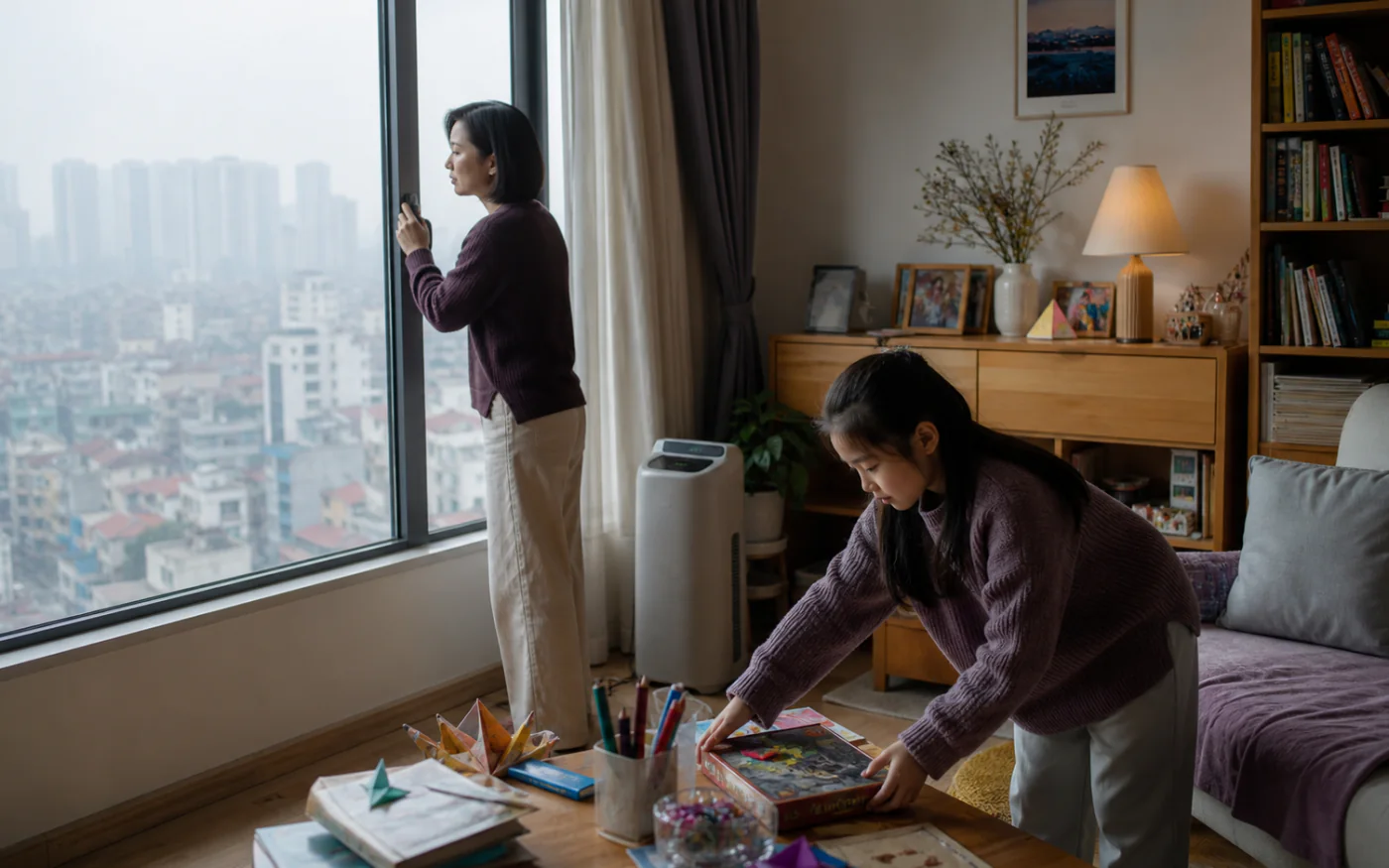
Moving indoors changes the exposure setting; it does not automatically guarantee safety. Avoid adding smoke indoors, and use suitable particle filtration if available. Air conditioning that cools a room does not, by itself, establish effective fine-particle removal. If windows are closed against polluted air, the room must still remain comfortably cool. Do not keep a child in an overheating room solely because outside AQI is poor; seek a feasible option that addresses both heat and air.
Masks have their own limits. CDC/NIOSH advises against masks or respirators for children under 2. For older children, fit and correct use matter; a child-size label does not guarantee a seal. Cloth or surgical masks are not equivalent to well-fitting particle respirators for reducing smoke-particle inhalation. Even suitable protection cannot cool the body or remove every pollutant, so it is not a reason to extend an outing that should be shortened.
Bring drinks without making the child responsible for safety
A child absorbed in play may not ask for a break or a drink. For children already drinking water as appropriate for their age, caregivers can offer it regularly during quiet pauses rather than wait for a request. Adult fluid targets are not children's targets. For a milk-fed baby, continue appropriate feeding, offer additional feeding opportunities as needed and prepare formula as directed; seek healthcare advice if feeding falls or adequate intake becomes difficult.
When several adults share care, a specific handover is better than everyone assuming someone else is watching: They have just had a drink; this is our resting place; this person will take them out if we leave. With older siblings, split the plan rather than require the youngest to finish every activity. At home, a safe space for dancing or a simple finding game can preserve active play without making the indoor option feel like punishment.
Stop early, and recognize an emergency
Coughing, wheezing or chest tightness are reasons to stop and leave poor air; continuing symptoms need medical assessment. Headache, dizziness, nausea or unusual weakness in heat call for ending play and moving somewhere cool immediately, with prompt medical advice, especially for a young child. Do not dismiss changes as fussiness or something to push through. An exit plan works only when adults are willing to abandon the itinerary in response to what the child actually shows.
Confusion, a seizure, unconsciousness or severe breathing difficulty requires emergency help immediately. If heatstroke is suspected, move the child out of heat, remove excess outer clothing and cool the skin with cool water or wet cloths while help is arranged; do not give food or drinks for suspected heatstroke. Do not wait for a thermometer or a predetermined interval. Ending an outing early can be the right outcome: the priority is noticing what the child needs now, not protecting the promised schedule.
Practical checklist
- Before departure, match the AQI scale, location and update time with destination heat warnings.
- Choose a cooler, cleaner-air retreat and a return option without a long outdoor wait.
- Agree who carries drinks and prescribed medicines, and who takes the child out if needed.
- Tell companions that shortening the outing or moving indoors does not require making up the itinerary.
From the guide to your next step
How NIMO built this guide
NIMO writes and localizes each guide for Vietnamese families, then checks key facts against the official references below. The links support the guide; they are not the guide itself.
General health information · Checked against official sourcesFor symptoms or treatment decisions, confirm with an appropriate health professional.Next review · Dec 5, 2026